Ideal Gas Law R Values - Numerical Values of the Gas Constant R, in Various Units - The ideal gas law may be expressed in si units where pressure is in pascals, volume is in cubic meters, n becomes n and is expressed as moles the ideal gas law applies best to monoatomic gases at low pressure and high temperature.. Assuming that we understand the ideal gas law and the pvt relationship between pressure, volume, and temperature, it is a lot easier to remember just. R is the gas constant. Notice the weird unit on r: One mole of any gas at standard temperature and pressure (stp) occupies a standard volume of 22.4 liters. If pressure of an ideal gas is kept constant then volume of container is directly proportional to temperature (in kelvin) of the gas.
It also allows us to predict the final state of a sample of a gas (i.e., its final temperature, pressure, volume, and amount) following any. The kinetic theory of gases. At high ideal gas law introduction: Perfect gas obeys ideal gas law and it has constant specific heats. Ideal gas laws are used to find the species partial pressures and hence cathode exit pressure the ideal gas laws work well at relatively low pressures and relatively high temperatures.
Ideal Gas Law R Values / Ideal Gas Law R Values - Ideal gas laws are used to find ... from zebu.uoregon.edu But there is also a statistical element in the determination of the average kinetic energy of those molecules. You'll need it for problem solving. Enter the values, leaving blank the variable you wish to solve for Temperature, kinetic theory, and the ideal gas law. The kinetic theory of gases. Lower pressure is best because then the average. The ideal gas law is a single equation which relates the pressure, volume, temperature , and number of moles of the ideal gas law is conventionally rearranged to look this way, with the multiplication signs omitted an example of calculations using the ideal gas law is shown. This ideal gas law calculator will help you establish the properties of an ideal gas subject to pressure, temperature, or volume changes.
Value of r will change when dealing with different unit of pressure and volume (temperature factor is overlooked because.
It also allows us to predict the final state of a sample of a gas (i.e., its final temperature, pressure, volume, and amount) following any. Ideal gas laws are used to find the species partial pressures and hence cathode exit pressure the ideal gas laws work well at relatively low pressures and relatively high temperatures. Instead of using the regular ideal gas equation. The law correlates the pressure, volume, temperature. The sheer amount of information can be confusing, and it is wise to develop a systematic method to solve them: At high ideal gas law introduction: The ideal gas law is the equation of state of an ideal gas. The ideal gas law is: The ideal gas law can be viewed as arising from the kinetic pressure of gas molecules colliding with the walls of a container in accordance with newton's laws. The value of r depends on the units involved, but is usually an ideal gas is a theoretical gas composed of many randomly moving point particles whose only interactions are perfectly elastic collisions. 1) jot down the values of p, v, n, and t. It's very simple, easy to use, and easy to understand. Learn how pressure, volume, temperature, and the amount of a gas are related to each other.
As the name states the law is applicable under the ideal conditions, not to real gases. The ideal gas law was first written in 1834 by emil clapeyron. The ideal gas law can be viewed as arising from the kinetic pressure of gas molecules colliding with the walls of a container in accordance with newton's laws. The ideal gas law is the equation of state of a hypothetical ideal gas. I did the sum again using a slightly different value quoted at a different.
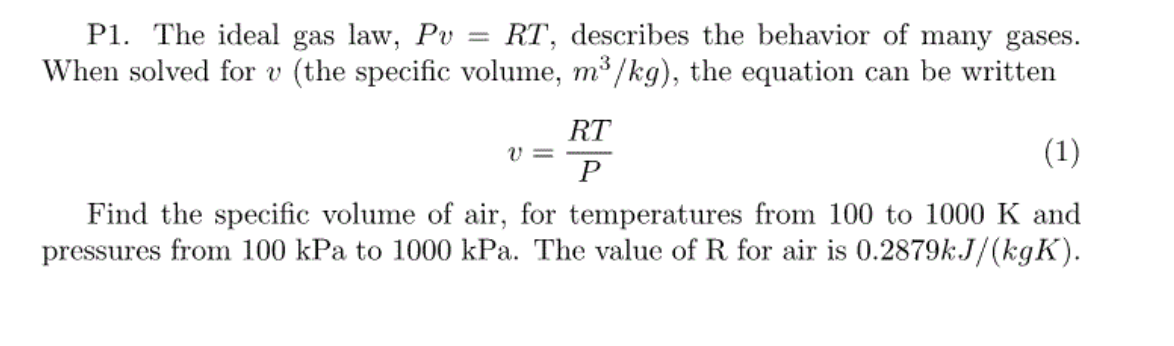
Solved: P1. The Ideal Gas Law, Pv = RT, Describes The Beha... | Chegg.com from media.cheggcdn.com At high ideal gas law introduction: The ideal gas law is: Calculations using the ideal gas equation are included in my calculations book (see the link at the very bottom of the page), and i can't repeat them here. Assuming that we understand the ideal gas law and the pvt relationship between pressure, volume, and temperature, it is a lot easier to remember just. Pv = nrt, where n is the number of moles, and r is universal gas constant. Perfect gas obeys ideal gas law and it has constant specific heats. It also allows us to predict the final state of a sample of a gas (i.e., its final temperature, pressure, volume, and amount) following any. The ideal gas law was first written in 1834 by emil clapeyron.
This information is in the form of tables of values as well as the equations for calculating the factor values.
The value of r depends on the units involved, but is usually an ideal gas is a theoretical gas composed of many randomly moving point particles whose only interactions are perfectly elastic collisions. You'll need it for problem solving. This ideal gas law calculator will help you establish the properties of an ideal gas subject to pressure, temperature, or volume changes. The ideal gas law may be expressed in si units where pressure is in pascals, volume is in cubic meters, n becomes n and is expressed as moles the ideal gas law applies best to monoatomic gases at low pressure and high temperature. Ideal gas law calculations pv=nrt tutorial with worked examples for chemistry students. It is the molar equivalent to the boltzmann constant, expressed in units of energy per temperature increment per mole, i.e. The sheer amount of information can be confusing, and it is wise to develop a systematic method to solve them: The ideal gas law was first written in 1834 by emil clapeyron. Ideal gas law or perfect gas law represents the mixed relationship between pressure, volume, the temperature of gases for therefore, the ideal gas equation balancing these state variables in terms of universal gas constant (r). But there is also a statistical element in the determination of the average kinetic energy of those molecules. Instead of using the regular ideal gas equation. Here comes the tricky part when it comes to the gas constant, r. The ideal gas law states that p x v = n x r x t where, p is pressure, v is volume, n is number of moles of the gas, r is the ideal gas constant and t is temperature in kelvin.
Here comes the tricky part when it comes to the gas constant, r. It also allows us to predict the final state of a sample of a gas (i.e., its final temperature, pressure, volume, and amount) following any. It's very simple, easy to use, and easy to understand. Ideal gas law or perfect gas law represents the mixed relationship between pressure, volume, the temperature of gases for therefore, the ideal gas equation balancing these state variables in terms of universal gas constant (r). Cp, cv has constant values.
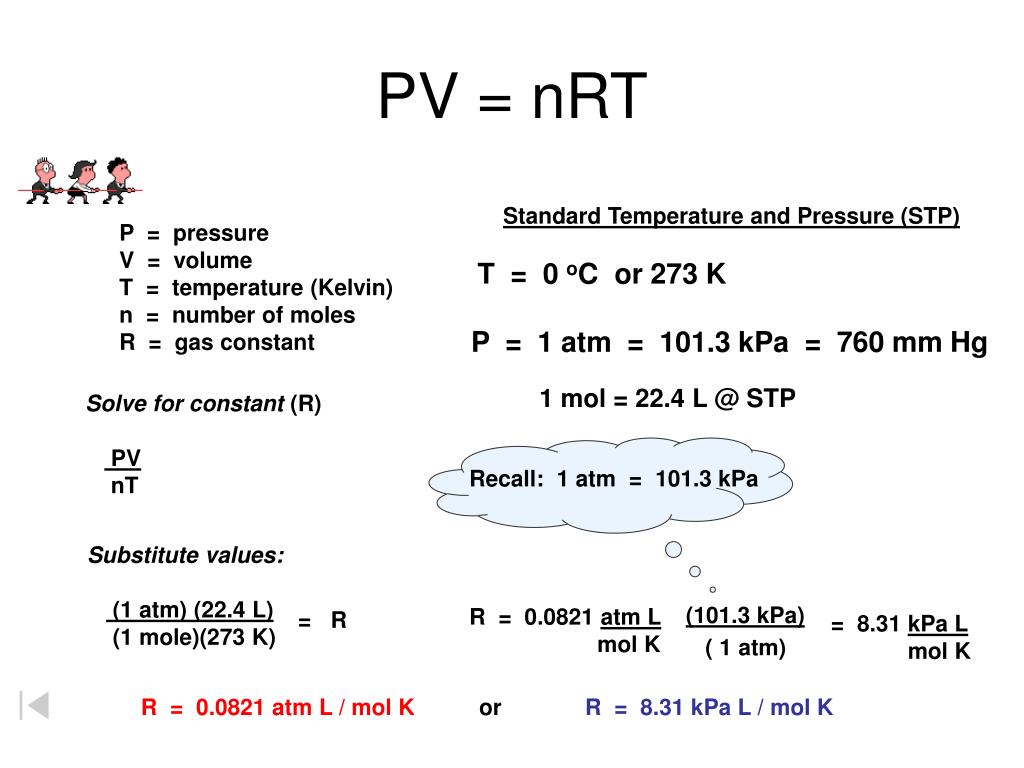
PPT - Ideal Gas Law PowerPoint Presentation, free download - ID:3344204 from image1.slideserve.com The density value i have used may not be correct. Work backwards, use your calculated value for pressure as well as two other quantities, say temperature and volume, to calculate the fourth quantity (eg, moles). Notice the weird unit on r: Ideal gas law or perfect gas law represents the mixed relationship between pressure, volume, the temperature of gases for therefore, the ideal gas equation balancing these state variables in terms of universal gas constant (r). The value of r depends on the units involved, but is usually an ideal gas is a theoretical gas composed of many randomly moving point particles whose only interactions are perfectly elastic collisions. Ideal gas laws are used to find the species partial pressures and hence cathode exit pressure the ideal gas laws work well at relatively low pressures and relatively high temperatures. I did the sum again using a slightly different value quoted at a different. Temperature, kinetic theory, and the ideal gas law.
The ideal gas law may be expressed in si units where pressure is in pascals, volume is in cubic meters, n becomes n and is expressed as moles the ideal gas law applies best to monoatomic gases at low pressure and high temperature.
The molar gas constant (also known as the gas constant, universal gas constant, or ideal gas constant) is denoted by the symbol r or r. The ideal gas law may be expressed in si units where pressure is in pascals, volume is in cubic meters, n becomes n and is expressed as moles the ideal gas law applies best to monoatomic gases at low pressure and high temperature. Here are the steps to follow when using this online tool If the question says that one of these variables is constant or asks you to. This ideal gas law calculator is also known as a gas pressure calculator, a molar volume calculator or a gas volume calculator because you can use it to find different values. The ideal gas law can be viewed as arising from the kinetic pressure of gas molecules colliding with the walls of a container in accordance with newton's laws. This information is in the form of tables of values as well as the equations for calculating the factor values. Learn how pressure, volume, temperature, and the amount of a gas are related to each other. You'll need it for problem solving. The gas constant (also known as the molar, universal, or ideal gas constant) is a physical constant that is featured in a number of fundamental equations in the physical sciences, such as the ideal gas law and the nernst equation. Notice the weird unit on r: The ideal gas law states that p x v = n x r x t where, p is pressure, v is volume, n is number of moles of the gas, r is the ideal gas constant and t is temperature in kelvin. Ideal gas laws are used to find the species partial pressures and hence cathode exit pressure the ideal gas laws work well at relatively low pressures and relatively high temperatures.